 Kidney Tracker
Tracking interdialytic weight gain at home
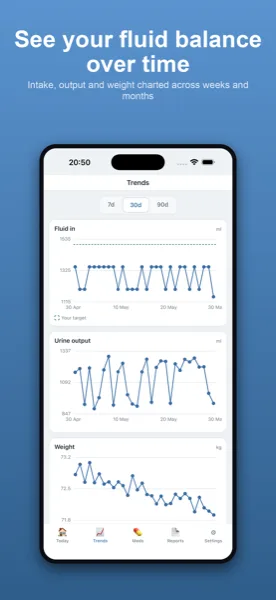
The change between one session and the next is easier to follow when you can see it drawn out, rather than comparing two numbers from memory.
If you are on dialysis, weighing yourself between sessions is something many people are asked to do. The gain from one session to the next — what teams sometimes call interdialytic weight gain — is a number that often comes up. This post is about keeping that record well: logging each weight and seeing how it moves over time. It is not about what any gain means or what to do about it. That belongs entirely with your own team, and Kidney Tracker stays out of it.
Why a notebook drifts out of date
Weighing yourself is quick, but a paper record of it is surprisingly easy to let slip. A weight noted on one scrap and not another, a day missed, a figure you meant to write down and didn't — and the picture between sessions develops gaps. Two readings on their own also do not show you much; what you usually want is the pattern across several days, and a list of loose numbers makes that pattern hard to see.
Log each weight in seconds
Kidney Tracker lets you record your weight whenever you step on the scales, in a couple of seconds, so it is realistic to keep it up around your dialysis schedule. Each entry is timestamped, so you always know when a reading was taken — useful when you want to relate a weight to a session. Because logging is quick, the record stays complete, which is what makes everything that follows worthwhile.
See the change, not just the latest figure
Your weights are plotted on a chart, so instead of comparing two numbers in your head you can see the rise and fall across the week. The shape between sessions is far easier to read — and far easier to describe to your team — when it is a line rather than a column of figures. The boundary matters here: the chart shows exactly what you entered. Kidney Tracker does not set a target or dry weight, does not judge whether a gain is large or small, and offers no advice. If you record a target weight your team has given you, that is your number, not the app's suggestion.
Weight and fluid in one place
Because your weight sits in the same app as your fluid log, you can keep both together rather than juggling separate records. To keep the habit easy, you can glance at your latest weight on a home-screen widget or an Apple Watch complication, and add an entry hands-free with Siri. Everything stays on your own iPhone — no account, nothing uploaded — and if you want to talk it through at a session, you can bring a printable report generated on your device that includes your weight history. It goes only where you choose to send it.
The weight tracking page covers charting weight in more detail, and the dialysis page looks at logging around your sessions. You may also like the post on managing a fluid restriction on haemodialysis.
Kidney Tracker is a personal record-keeping tool. It is not a medical device and does not provide medical advice — always follow your own clinical team.
FAQ
Common questions
Follow your weight between sessions
Kidney Tracker is in beta and free to try. Join through TestFlight — no account needed.
Join the beta on TestFlightiPhone only for now · Free during beta