 Kidney Tracker
What people often track through the CKD stages
A plain look at the kinds of everyday records people are often asked to keep — and how to log each of them in one private place.
People living with chronic kidney disease are often asked by their team to keep an eye on a few everyday measures, and what those are can change over time. This post is a plain look at the kinds of records people commonly keep, and how each one can be logged in a single app. It is important to be clear up front: this is not a guide to what you should track, and nothing here defines the CKD stages or gives advice. What to keep an eye on, and when, is for your own team to decide. Kidney Tracker just holds whatever you choose to record.
The kinds of records people keep
Across the things teams commonly ask about, a handful come up again and again — not as instructions from us, but simply as the records people tend to mention keeping. Here is how each one works in the app, so you can see what is possible if your team has asked you to keep it.
Fluid, weight and blood pressure
Fluid is logged in millilitres, in and out, with a live running total on the Today screen and a net balance against any target you set yourself. Weight is a couple of taps and is plotted over time. Blood pressure is recorded as systolic and diastolic, with pulse if you take it, each entry timestamped and charted. If you were given a daily fluid figure, you enter it as your own target and the app totals against it — the number is yours, taken from your team.
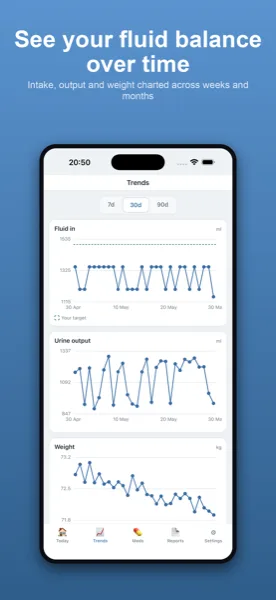
Temperature, glucose and medications
You can also record temperature and glucose readings when those are part of what you keep an eye on, each saved with a time and shown on a chart. For medicines, you can keep a personal list and set local reminders on your iPhone for the times you choose. The reminders are notifications on your own device — nothing goes through a server, and the app never advises on doses or timing. You set everything from your team's instructions.
Blood results and the bigger picture
The values your clinic reads back to you at appointments can be noted down and followed on a simple chart, so your own copy lives alongside everything else rather than scattered across letters. Across all of these, the app does the same job: it records what you enter, totals and charts it, and never judges a value, flags anything, or offers an opinion. The clinical reading stays with your team.
Start small, keep it private
You do not have to log everything. Many people start with one or two measures and add more if their routine changes. Whatever you keep, it stays on your own iPhone — no account, nothing uploaded — and you can glance at recent figures on a home-screen widget or an Apple Watch complication, or add an entry hands-free with Siri. When an appointment comes up, a printable report generated on your device pulls it together to share as you choose.
The chronic kidney disease page covers day-to-day logging, and the features page lists everything the app records. You may also like the posts on blood pressure and weight tracking with CKD and keeping a fluid and symptom diary with advanced CKD.
Kidney Tracker is a personal record-keeping tool. It is not a medical device and does not provide medical advice — always follow your own clinical team.
FAQ
Common questions
Keep your records in one private place
Kidney Tracker is in beta and free to try. Join through TestFlight — no account needed.
Join the beta on TestFlightiPhone only for now · Free during beta