 Kidney Tracker
Fluid and weight logging on peritoneal dialysis
Treatment happens at home, and so does the record-keeping. One tidy place for fluid and weight makes the daily routine lighter.
Peritoneal dialysis is done at home, and that means the day-to-day record-keeping falls to you rather than to a ward. Many people are asked by their team to keep an eye on their fluids and their weight as part of the routine. This post is about the practical side of that — logging the numbers and letting the app do the totalling — and not about the clinical side, which belongs with your own team. Whatever you have been asked to record, the goal here is simply to make recording it easy.
The home routine that quietly adds up
A home routine has a lot of small moving parts, and the record-keeping is the part most easily left until later — at which point the details are fuzzy. A drink not noted, a weight not written down, a figure half-remembered: across a week these gaps add up, and a record with holes is harder to rely on. Keeping it on the phone you already carry removes most of that friction, because you can log in the moment rather than reconstructing the day afterwards.
Fluid in and out, totalled for you
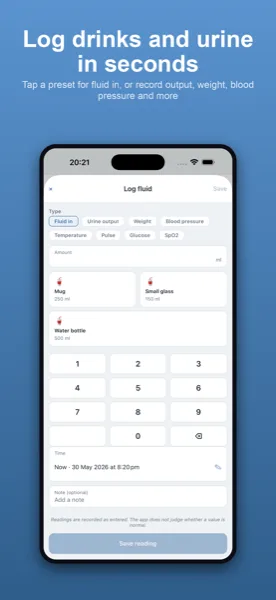
Kidney Tracker lets you record intake and output in millilitres as you go. You can save the amounts you use most so a familiar drink is a single tap, and the Today screen keeps a live running total of intake and of output, with your net balance shown alongside. There is no column to add up at the end of the day. If your team gave you a daily figure to work around, you enter it as your own target and the app totals against it. To be clear, that target is your number, taken from your team's instructions — the app does not choose it, does not judge your balance in any clinical sense, and gives no advice.
Weight in the same place
If weighing yourself is part of your routine, record it whenever you step on the scales and the app plots it over the days and weeks. Because your weight sits in the same app as your fluid records, you are not juggling a separate notebook, and you can see both threads in one place. A configurable day-start hour lets your daily totals line up with the 24-hour window your team uses rather than resetting at midnight.
Quick to keep up, private to you
So the routine stays light, you can add a drink hands-free with Siri, keep your totals in view on a home-screen widget, or glance at an Apple Watch complication. Everything stays on your own iPhone — there is no account, nothing is uploaded, and the developer never sees your data. When a clinic visit comes round you can turn your records into a printable, shareable report generated on your device; it goes only where you choose to send it.
The peritoneal dialysis page covers this routine in more detail, and the fluid balance chart page looks at intake-and-output logging. You may also like the post on tracking weight between dialysis sessions.
Kidney Tracker is a personal record-keeping tool. It is not a medical device and does not provide medical advice — always follow your own clinical team.
FAQ
Common questions
Keep your PD record in one place
Kidney Tracker is in beta and free to try. Join through TestFlight — no account needed.
Join the beta on TestFlightiPhone only for now · Free during beta