 Kidney Tracker
Keeping records at CKD stage 3
How to start a light, private home record early — about the writing-down, not the clinical staging.
If you have recently been told you are at an earlier stage of chronic kidney disease, you may have been asked to start keeping an eye on a few everyday measures at home. This post is about the record-keeping side of that — not what the stage means, what to track, or what any reading should be, all of which are for your own kidney team. What we can help with is the practical question of how to keep those records tidy and in one place from the start.
Starting a record while things are stable
At an earlier stage, many people are seen less often and asked simply to keep a light record between appointments. That is the ideal time to set up a habit, because there is no rush and you can keep it gentle. Kidney Tracker lets you log only what you want — perhaps weight and blood pressure to begin with — and add other measures later if your routine changes. Nothing is mandatory and the app never tells you what to record.
The measures people tend to keep
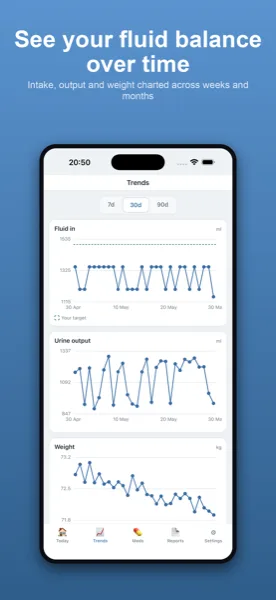
Across the things teams commonly ask about, weight and blood pressure are the ones people most often mention keeping at this point, alongside the blood results read back to them at appointments. In the app, weight is a couple of taps and is plotted over time; blood pressure is logged as systolic and diastolic with pulse if you take it; and the values from your clinic can be noted so your own copy lives alongside everything else. Each is timestamped and charted, and none is ever judged or flagged.
Keeping it low-effort
A record you keep for months only works if it is easy. Entries take a couple of taps, you can add one with Siri, and a home-screen widget or Apple Watch complication shows recent figures at a glance. Because appointments can be spread out, having a steady home record means you are not trying to remember readings from weeks ago when you next sit down with your team.
Ready for the next review
When a review comes round, a printable report generated on your device gathers your readings over the dates you choose into one tidy summary to share as you wish. Everything stays on your own iPhone — no account, nothing uploaded — so an early, private record can quietly build up over time.
Why an early habit pays off later
The value of starting a record while things are quiet is that the habit is already there if your routine ever changes. Picking up a new way of recording at a busy moment is harder than carrying on with one you already know. Because the app is the same whatever you log, a record begun with a single weekly weigh-in can grow into something fuller without you ever switching tools or learning a new screen. Nothing about that is pushed on you — the app simply makes it easy to add more if and when your team asks.
A record that is genuinely yours
One thing that surprises people is how reassuring it is to hold their own copy of the numbers. Between appointments, your record is not locked away in a letter or a system you cannot see — it is on your phone, in your hands, drawn out plainly. The app does not grade it, colour it or comment on it; it just keeps it. That neutrality is deliberate, because the reading of any figure stays with your team, and your job is only to keep the record tidy.
For the bigger picture across stages, see what people often track through the CKD stages and the chronic kidney disease page. The post on blood pressure and weight tracking with CKD goes deeper on those two readings.
Kidney Tracker is a personal record-keeping tool. It is not a medical device and does not provide medical advice — always follow your own clinical team.
FAQ
Common questions
Keep your records in one private place
Kidney Tracker is in beta and free to try. Join through TestFlight — no account needed.
Join the beta on TestFlightiPhone only for now · Free during beta