 Kidney Tracker
Keeping records around dialysis decisions at CKD stage 5
How a tidy personal record can sit alongside big treatment conversations — the app gives no advice.
When chronic kidney disease reaches its most advanced stage, conversations often turn to bigger decisions about treatment. This post does not enter that clinical ground at all — what those decisions are, when to make them, and what is right for you are entirely matters for your own kidney team. What it covers is something much narrower and practical: how a tidy personal record can sit alongside those conversations, so that whatever you discuss, your own notes and readings are easy to find.
Why a record helps around big conversations
Appointments at this stage can carry a lot, and it is easy to leave wishing you had a figure to hand or a question written down. Keeping your own record between visits means you arrive with your recent readings already in order. Kidney Tracker holds whatever you choose to log — fluid in and out, weight, blood pressure, temperature, glucose, blood results — each timestamped and chartable, so nothing has to be reconstructed from memory.
Keeping questions and readings together
Because everything sits in one app, the readings you might want to refer to are in the same place. The app does not advise on any option, weigh choices, or interpret a value — that stays firmly with your team. It simply keeps your own copy of the numbers tidy, which can make a busy appointment feel a little more manageable.
A summary you can take in
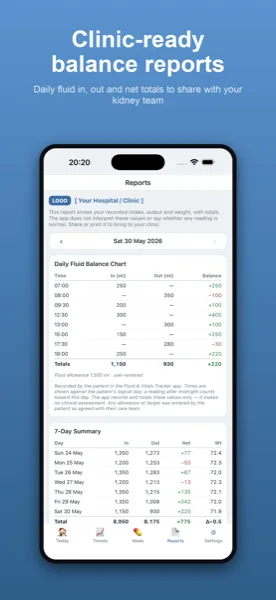
A printable report generated on your device gathers your records over the dates you choose into one clean summary. Having a tidy printout can help you follow a discussion and share your record where you wish. It is your information, organised — not a recommendation about anything.
Private, and yours
Everything stays on your own iPhone. There is no account, nothing is uploaded, and any report is created locally and shared only where you decide. Whatever path your care takes, your personal record remains in your hands.
Arriving with your record in order
Big appointments often follow a stretch of closer monitoring at home, and the readings from that stretch are easier to discuss when they are already gathered. Rather than trying to recall how the last few weeks have gone, you can open a tidy record and, if you wish, a printout that lays the figures out plainly. The app does not summarise in words or highlight anything — it presents what you entered, dated and charted, so the record supports the conversation without trying to steer it.
Whatever the decision, the record stays yours
Treatment paths differ from person to person, and your record travels with you whichever way things go. If care moves toward a particular treatment, the same app keeps logging through the change; if plans shift again, nothing is lost. Because everything lives on your own device with no account, your history is not tied to any one setting or service. The app is simply a private place to keep your own copy of the numbers, steady through whatever your team and you decide together.
For the wider view, see what people often track through the CKD stages and the dialysis page. If treatment moves to PD, the post on keeping a daily PD record at home may help.
Kidney Tracker is a personal record-keeping tool. It is not a medical device and does not provide medical advice — always follow your own clinical team.
FAQ
Common questions
Keep your records in one private place
Kidney Tracker is in beta and free to try. Join through TestFlight — no account needed.
Join the beta on TestFlightiPhone only for now · Free during beta